You probably heard about new, affordable, Open-Weight/Open Source LLMs from providers other than Anthropic or OpenAI.
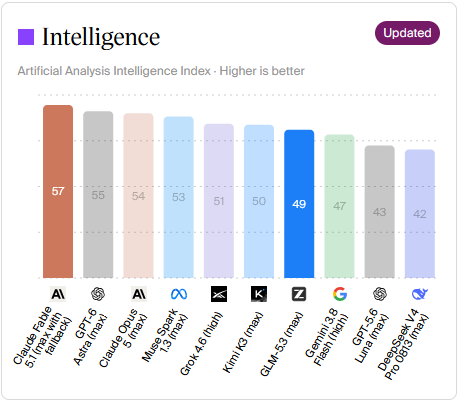
Take for example GLM 5.3 model from Z.ai. At the moment of writing, it has a score of 49 on Artificial Analysis Intelligence benchmark, while the currently highest ranking model, Claude Fable 5.1 from Anthropic has a score of 57.
This is the current pricing for GLM 5.3 and Claude Fable 5.1 for uncached responses:
| Model | Input (1M tokens) | Output (1M tokens) | Intelligence Score |
|---|---|---|---|
GLM 5.3 |
$1.15 | $3.50 | 49 |
Claude Fable 5.1 |
$10.00 | $50.00 | 57 |
That means with GLM 5.3 we get 85% of the capabilities of the frontier model for only ~10% of the price!
But how do we use those models?
Almost all the flagship models have a web UI or a GUI application that reminds of VS Code. Web UI is great for its simplicity and graphics, VS Code-like GUIs are great for being able to browse the code while running an agent and for code completion.
However, for running an agent on the server or from terminal, the ideal way is to use a CLI.
With an Anthropic or OpenAI subscription, we can run agents locally. This follows a client-server analogy, where we locally run only a client, often called “harness”, which has access to files on the local machine, but makes API requests to the server, a.k.a. Anthropic/OpenAI APIs.
Anthropic has its own harness called Claude Code which runs on your local machine. This harness reads the files locally and sends requests for inference (the compute-heavy part of using LLMs) to Anthropic’s API.
OpenAI also has its own harness called Codex which makes requests to OpenAI’s API.
Z.ai has ZCode which is a VS Code-like GUI
Kimi has Kimi Code
DeepSeek has DeepSeek Harness that is currently in preview
Qwen.ai has Qwen Code.
We could of course subscribe to a provider of our liking and use its own harness, e.g. Kimi Code for Kimi models. However, this locks us into a single service at a time when the LLM landscape is changing almost on a weekly basis.
What we could do instead is use one harness for multiple providers and switch between models easier.
OpenCode
OpenCode is an Open Source agent that allows connecting to multiple providers.

You can use “OpenRouter” provider from OpenCode, which allows you to buy credits in one place (OpenRouter) and use models from different providers on a pay-as-you-go basis.
You can also use OpenCode’s pay-as-you-go offering called Zen.
You can even take advantage of free models. Those are available for free for a limited time, while the providers are collecting feedback and improving the model.
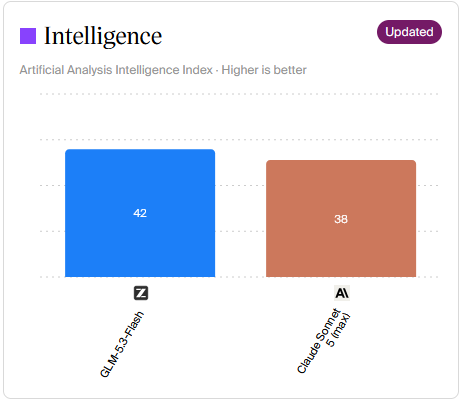
Free models are good enough for general work, if frontier capabilities are not a priority. However, there are sometimes quite capable models offered for free for a limited time. Those usually have a codename like “OxAlpha” (later revealed to be Z.ai’s GLM 5.3-Flash) or “Big Pickle”, as they are in “Stealth Mode”.
It turned out that GLM 5.3-Flash is more capable than Claude Sonnet 5, and it was free!
The only caveat here is that the prompts might be used for training, if that is a concern.
Using Claude Code with other providers
If you don’t feel like leaving your preferred agent, there are sometimes ways to use it with other providers.
For example, Claude Code can be hosted on companies’ own infrastructure, if needed, so there is an option to tell Claude Code where the “server” is. This is done by passing the URL of the server to Claude Code using ANTHROPIC_BASE_URL environment variable.

Some LLM providers, like DeepSeek, take advantage of this mechanism to have their own, lower cost, models available to use with Claude Code that you already have installed.
They do this by providing an Anthropic-compatible API, while running their own models behind the API.
This means that if we set these environment variables prior to running Claude Code (we can save this in ~/.bashrc):
export ANTHROPIC_BASE_URL=https://api.deepseek.com/anthropic
export ANTHROPIC_AUTH_TOKEN=<your DeepSeek API Key>
export ANTHROPIC_MODEL=deepseek-flash[1m]
export ANTHROPIC_DEFAULT_OPUS_MODEL=deepseek-flash[1m]
export ANTHROPIC_DEFAULT_SONNET_MODEL=deepseek-flash[1m]
export ANTHROPIC_DEFAULT_HAIKU_MODEL=deepseek-flash
export CLAUDE_CODE_SUBAGENT_MODEL=deepseek-flash
export CLAUDE_CODE_EFFORT_LEVEL=max
export CLAUDE_CODE_AUTO_COMPACT_WINDOW=786432
we will have Claude Code on our machine making calls to lower cost DeepSeek models!
We can replicate the same setup with Codex, as well. It is configured using a config file rather than environment variables, but the principle is the same - point the agent to an alternative “server” address.